

Diagnosing a Learning Disability at Age 40: Hello, Dysgraphia!
Well, thank goodness I can type!👩🏻💻

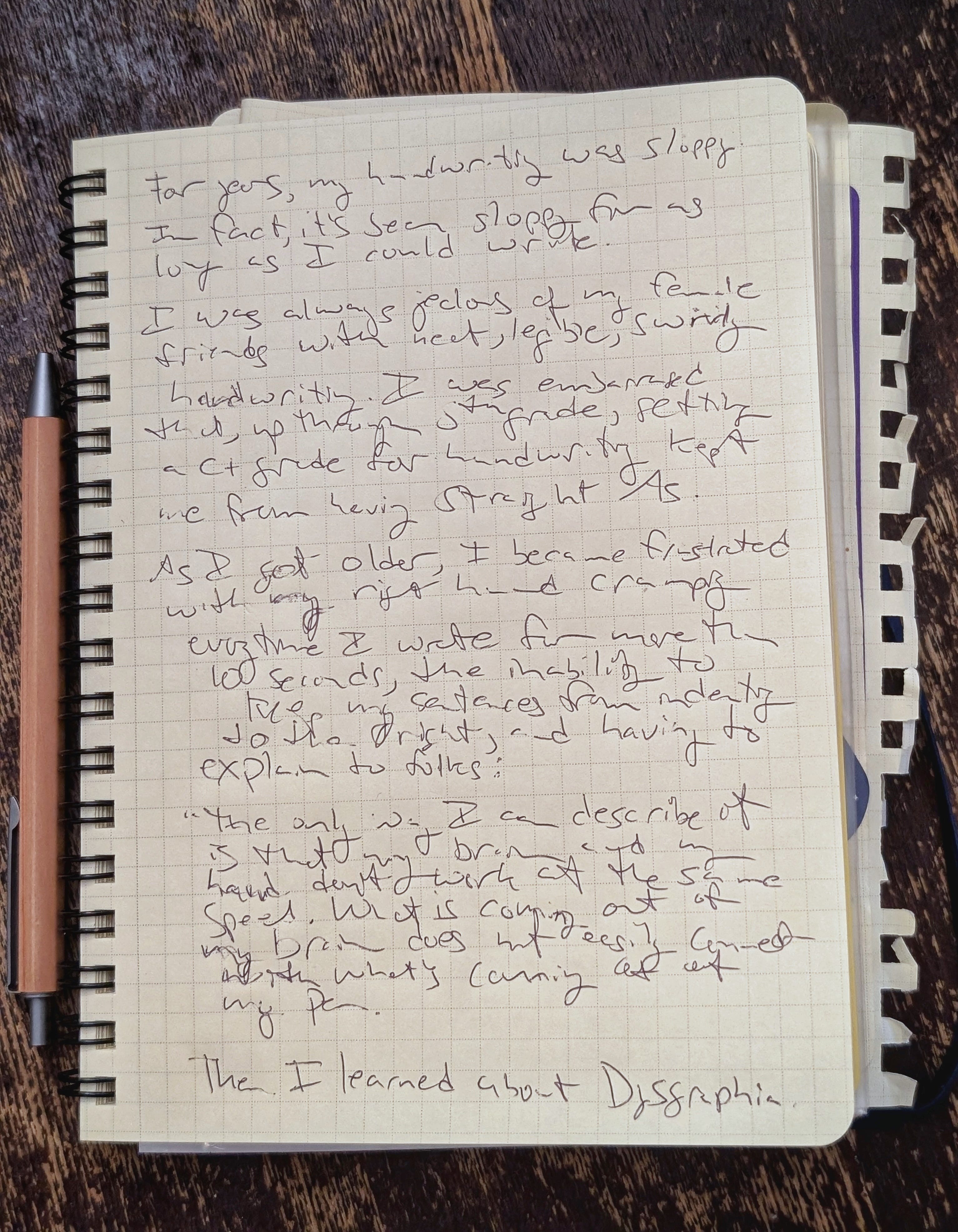
Can you read what I wrote?
Don’t worry, babes. I can barely either, and I wrote it!
Allow me to translate:
For years, my handwriting was sloppy. In fact, it’s been sloppy for as long as I could write.
I was always jealous of my female friends with neat, legible, swirly handwriting. I was embarrassed that, up through 5th grade, getting a C+ grade for handwriting kept me from getting straight As.
As I got older, I became frustrated with my right hand cramping every time I wrote for more than 10 seconds, the inability to keep my sentences from indenting to the right, and having to explain to folks:
“The only way I can describe it is that my brain and my hand don’t work at the same speed. What is coming out of my brain does not easily connect with what’s coming out of my pen.”
Then I learned about dysgraphia.
Dysgraphia, per The Cleveland Clinic, is defined as a neurological condition in which someone has difficulty turning their thoughts into written language for their age and ability to think, despite exposure to adequate instruction and education.
*phew*
Now imagine growing up in the 1990s. Not only did we elementary school-aged kiddos need to learn regular and block handwriting, but - come my arrival to 4th grade - we also had to learn cursive. We were told this was a necessity and we’d be using it for the rest of our lives. While it was important to learn how to type on our then-impressive Apple IIe computers, writing would always be greater than typing.
Foresight into the world in 2025 did not exist in 1994.


How is dysgraphia diagnosed as an adult? Find a psychologist or psychiatrist who specializes in learning disorders, as well as a good occupational therapist or handwriting specialist. Needless to say, I figured out I had dysgraphia on my own, but someone with more credentials had to make the official call.
Is dysgraphia all - or - nothing? Not necessarily. I learned there are five common types of dysgraphia, and I have two of them: motor and spatial. Dyslexic, phonological, and lexical don’t apply to me.
Motor: The physical act of writing is incredibly daunting to me. I cannot hold a writing tool properly, according to experts, which causes my right hand to cramp up within about 10 seconds of writing anything out. As I’ve noted above, there is no better way for me to describe this than my hand and my brain do not receive signals at the same speed; my brain is often shooting signals faster than my hand can write them, then I write fast to keep pace, sometimes forgetting what I was trying to write because of the lag. I tend to blend letters, especially any words ending in “ing” or “ly”, which becomes a big, illegible loop. My letters are jagged yet bendy and - in my opinion - it looks like I was in a struggle between me and my writing instrument…because I was! I always am!
Spatial: Give me clearly-lined paper with defined margins, and I’ll STILL not be able to keep anything where it needs to be. I have an awful time with writing letters in the correct size, determining spacing between words, crowding my sentences together, and keeping up to proper margins. I still remember my 6th grade history teacher calling me out on it in a most unhelpful way when she’d see my school notes had sentences that kept drifting to the right; again, can I go back in time to get my teachers to understand this undiagnosed learning disability I had wasn’t an indicator that was a low-key thoughtless student?
Despite this digital world, I found myself confronted with my disability at work recently. While I was having a 1:1 with my director, she asked me to go to the whiteboard in her office to draw and conceptualize a workflow problem we were attempting to solve. My role involves spending a lot of time using a virtual ticketing system known as ServiceNow to collect data governance requests, and we refer to tickets by their RITM numbers. I had to write multiple RITMs on the whiteboard, which is spelled R-I-T-M with a combination of seven numbers after it, e.g., RITM0123456. (Got it? Good.) I was struggling to make my letters and numbers legible while trying to process her words to my brain to my right hand, which was shaking and cramping so badly. I was deeply in my head for those scant five minutes at the whiteboard, hoping that she was not judging how illegible it all was. I went back to my desk feeling deep embarrassment. I could not shake it for days.
Days later, a colleague comes over and sees some paragraphs I had scribbled in my work notebook. He needlessly commented on my handwriting being illegible. Being a little pissy due to a long work day, I cordially - yet - straight up told him that I had dysgraphia and what that was. He tried to backpedal, telling me that I looked like the type of person to have nicer handwriting.
(…like…what?!)
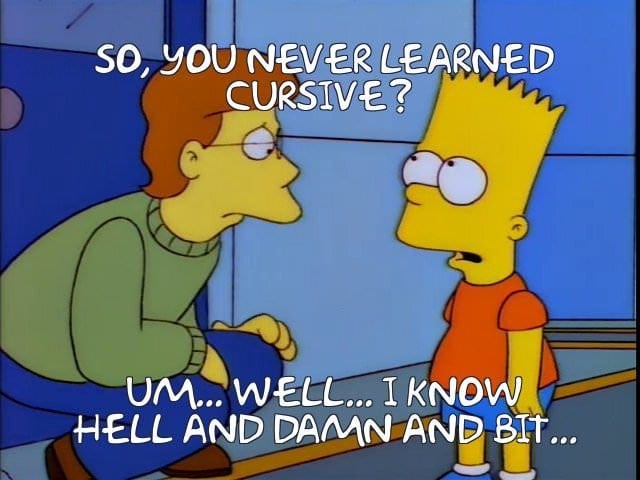
Hell, I may be doing a Classic Simpsons Trivia Night in Brooklyn with some friends next week, and I’m already sweating over who will write the answers down. (I’ll still do it because of control issues. That’s another story, haaa.)
What is the upside to all of this?
A diagnosis can bring a lot of emotions, but relief and the realization that “I’m not weird!” (at least in THIS case) flood in. It’s like that missing puzzle piece that JUST fits. The way I feel is tacit; it’s not easy to make explicit, but that explanation works in a nutshell, eh?
Now, knowing that I have dysgraphia, will I do anything about it?
Probably not, because we are in a digital world. Perhaps I’ll practice my Dynamic Tripod grip at some point…
(Heheh.)
Still, if I said this disability wasn’t a huge source of embarrassment for me, I’d be lying. Every time I put pen to paper, even if it’s for my eyes only, I feel uneasy. I can’t shake it. I doubt it’ll ever change.
Again: Thank goodness we live in a digital age. The keyboard is my best friend. I just wish I could be a journal girlie with pretty pens from Goods for the Study. Perhaps in a different timeline…
Call to Action: As you got older, were you ever diagnosed with a condition that plagued you in your youth? How did that impact your life?